

General DescriptionThe MAX5052A is a current-mode PWM controller. It contains all the necessary control circuitry required for the design of an isolated power supply. This application note describes the design of a 23W isolated power supply. The topology employed is a single transistor forward with synchronous rectification. Remote sense pins compensate for load cable voltage drops. The switching frequency of the MAX5052A is set at 262kHz and it is internally trimmed to ±12% accuracy. The MAX5052A has a maximum duty cycle of 50%.
Specifications
- Input voltage 40VDC–60VDC
- Power supply dimensions: 1.79" × 0.95" × 0.60"
- Output voltage: 3.3V ±2%
- Output current: 7A
- Over-voltage 4V ±5%
- Over-current and short circuit protection
- Remote sense
- No damage should occur to the remote sense resistors if the connections of the remote sense is reversed.
- Isolation voltage, primary to secondary 1500VDC.
Synchronous rectification on the secondary side is used to increase the power supply efficiency. The gate charge retention scheme is used to guarantee gate drive voltage on the freewheeling MOSFET when the transformer winding voltage has gone to zero. In a dc-dc converter with a two-to-one line swing of the input voltage, this time can be 50% of the duty cycle, or higher, at the highest input voltage. This is true in the case where the reset winding has the same number of turns as the primary power winding and the reset winding is returned to the input via a reset diode. In the current application the input voltage was changing from 40V to 60V.
The forward path synchronous MOSFET Q1 is turned on when the transformer voltage on the secondary goes positive and is turned off when the main switching FET is turned off. The freewheeling MOSFET Q4 is turned on when switch Q3 is turned off and the transformer voltage reverses. Once the transformer voltage goes to zero, MOSFET Q2 is kept on because there is no discharge path on the gate of Q2. When the primary switching FET Q3 is turned on, the MOSFET Q4 is turned on and this discharges Q2 rapidly resulting in the turn of off Q4.
U1 is the secondary feedback opto-coupler that sends the feedback signal across the isolation barrier. U5 is an opto-triac which shuts off the PWM controller in case of an over-voltage by discharging C2 and keeping it discharged until the input power is recycled. R23 and R18 are the positive and negative remote sense resistors. When the power supply hits the current limit the duty cycle will pitch back, causing the output voltage to drop. This will also cause the voltage across C14 to drop. Since the voltage across C14 is directly proportional to the output voltage, a heavy overload on the output would cause a sufficient drop in the bias voltage on C14 such that the voltage on C2 would drop below 9.9V causing the controller to shut down and go into a hiccup mode of operation, thus causing a reduction in the RMS short circuit current. This mode of operation of the power supply allows us to short the power supply output without overheating the output semiconductors and inductor. Diodes D9 and D10 provide an alternate path for the current when the remote sense wires are crossed. This will cause the output to be short-circuited by diodes D9 and D10 and will put the power supply into the hiccup mode of operation. This prevent the resistors R18 and R23 from opening up due to excessive current.
Performance DataPeak-to-peak ripple at an input voltage of 60V. Output 3.3V at 7A
Measured peak-to-peak ripple was 124mV at 20MHz bandwidth.

Figure 1.
Peak-to-peak ripple at an input voltage of 48V. Output 3.3V at 7A
Measured peak-to-peak ripple was 100mV with the bandwidth set at 20MHz.
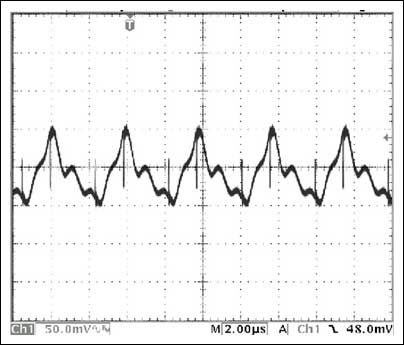
Figure 2.
The output ripple and noise could be further improved by increasing the number of output capacitors or by using output capacitors with lower ESR.
Transient ResponseTransient response measured at 48V input and a load step decrease from 5.25A to 3.5A.
The peak positive excursion was measured at 160mV.

Figure 3.
Transient response measured at 48V input and a load step increase from 3.5A to 5.25A.
Here the peak negative excursion was 220mV. The difference in behavior can be attributed to the change in crossover frequency and the phase margin at 3.5A and 5.25A.

Figure 4.
Table 1. Efficiency Data
PCB InformationThe PCB is compact and it has components on both sides. The dimensions along with the component placement are shown below.
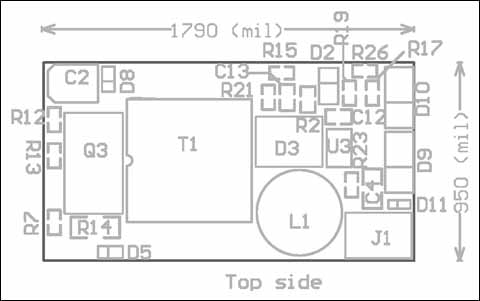
Figure 5.

Figure 6.
Table 2. Component List for 23W Power Supply
Panasonic EEVFK1H4R7R
Panasonic EEFUEOJ181R
Murata GA243DR7E2472MW01L
Vishay SUD70N02-09
Fairchild Semi FDD120AN15A0
Fairchild NDS351AN
Coilcraft DR0810-472
Panasonic MA115CT
Diodes Inc 1N4148W
Diodes Inc SBM835L
Panasonic MA2S784
Panasonic MA111CT
Diodes Inc B320A
Fairchild HMHA2801
Maxim MAX5052AEUA
Texas Instruments TLV431ACDBVR
Fairchild MOC3023
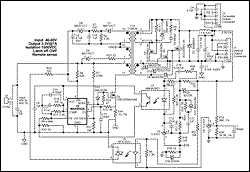
For Larger Image
Figure 7. Schematic of 23W power supply.
欢迎分享,转载请注明来源:内存溢出
 微信扫一扫
微信扫一扫
 支付宝扫一扫

评论列表(0条)