

免费
Where is ground in space? Usually engineering is strictly constrained by the laws of physics. Ground is an excepTIon, as engineers can get an ego boost because we can finally control and define something. It is so, just because we say so. It reminds us of the ego power employed by Humpty Dumpty in Lewis Carroll's Through the Looking-Glass.
"'When I use a word,' Humpty Dumpty said in a rather scornful tone, 'it means just what I choose it to mean—neither more nor less.'Defining ground in earth orbit emphasizes a possible confusion between "common" and engineering language use. This dichotomy applies equally to airplanes and automobiles driving on rubber tires. When we engineers say "ground," we really mean "reference point." This concept should be the beginning of our thought process. When we realize that we can make the term relative, we gain a certain freedom.
'The quesTIon is,' said Alice, 'whether you CAN make words mean so many different things.'
'The quesTIon is,' said Humpty Dumpty, 'which is to be master—that's all.'"¹
For safety reasons we keep our circuits referenced to our surroundings. In most cases this is earth ground. Common electrical building codes mandate that the AC power line be bonded to the earth as it enters the premises.
In power tools, insurance safety regulations allow a choice between grounding the metal case with a third wire safety ground or using double insulation. Similarly, we can maintain safety and define the local ground or reference point inside the equipment as we choose.
By separating the reference point from safety ground we can look at an IC data sheet in a new perspective.
A typical data sheet shows a device's Absolute Maximum Ratings. Figure 1 says that a pin named VCC needs to be within a certain voltage range compared to a pin named GND.

Figure 1. Typical listings for absolute values taken from a data sheet.
These values raise a question: could VCC and GND meet their relative voltage requirements and still be offset together by thousands of volts compared to something else? Yes, of course!
Practical Examples
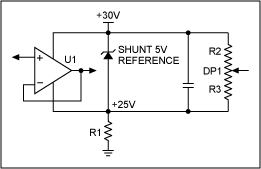
Figure 2. A diagram shows making ground a relative +25V.
Assume for the moment that an application needs a circuit to operate near a 30V supply, perhaps a sensor or a LCD contrast control. From Figure 2, the sensor can be buffered with U1 and AC-coupled to other circuits. DP1 can adjust bias gain or contrast. But how do you adjust DP1?

Figure 3. A digital pot floating near +30V with self-debouncing switches.
The MAX5174 up/down switches are momentary in the up-arrow direction. They are debounced because the switches mechanically chatter between one end at a time. The switches do not bounce between the two voltages. In simple terms, as the switch starts opening on the +25V side, the contact will bounce between open circuit and being connected to +25V. As the moving contact approaches the +30V side, the bounce similarly will be between open and +30V. The mechanics of the switch preclude a bounce between +25V and +30V.

Figure 4. A digital pot floating between +25V and +30V with internally debounced switches.
The DS1669, DS1809, and DS1869 digital potentiometers have internal 100kΩ pullup resistors. They have internal circuitry to debounce the switches and autoincrement the wiper position. The data sheet explains the repetitive pulse and continuous pulse ("push-and-hold") functions as well as an unique single-switch control configuration.

Figure 5. A switch-driven up/down/increment interface.
The up/down/increment interface of the MAX5450–MAX5455, MAX5471–MAX5475, and DS4301 devices debounces the switches. If the switch is held down it will autoincrement. See application note 1118, "Manually Operated Digital Potentiometer Doesn't Need a Microprocessor," for details.
Maxim's complete list of digital pots is available on the website.
¹Carroll, Lewis, Through the Looking-Glass, Chapter 6 (1872).
欢迎分享,转载请注明来源:内存溢出
 微信扫一扫
微信扫一扫
 支付宝扫一扫

评论列表(0条)